100-150 CCST Networking Certification Guide

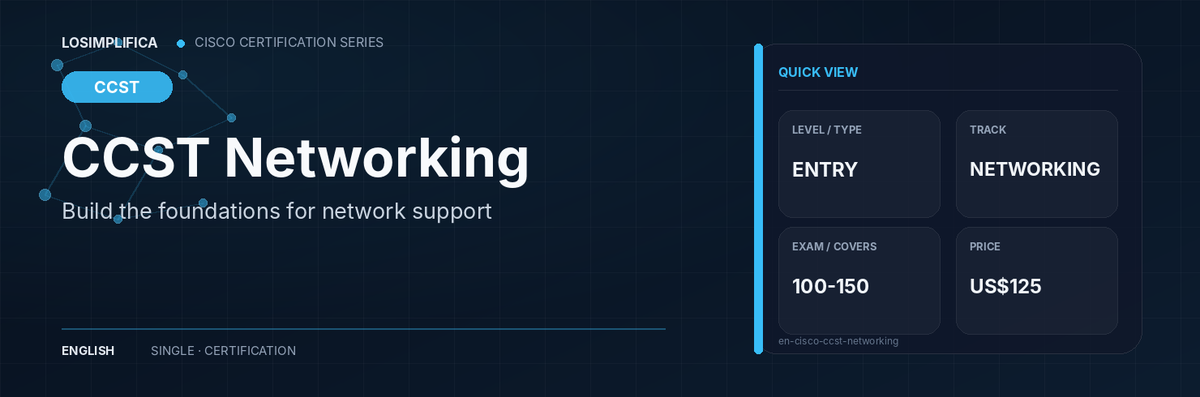
What is Cisco Certified Support Technician (CCST) Networking?
CCST Networking is Cisco's entry-level networking credential for learners who need a first, structured way into the field. It is aimed at students, career changers, technical support staff, and early-career learners who need to understand what actually happens when a device joins a network and tries to reach another system.
This is not an advanced routing certification. It is about building the working instincts behind entry-level support: recognizing devices and media, reading an IP configuration, checking whether a host can reach its gateway, and using evidence rather than guesswork when a connection fails. Cisco lists no formal prerequisite.
Quick facts
| Field | Current official information |
|---|---|
| Level | Entry |
| Track | Networking |
| Requirement | Pass one required exam |
| Primary exam | 100-150 CCST Networking |
| Minimum exam fees | US$125; taxes and local currency treatment may vary |
| Primary exam duration | 50 minutes |
| Concentration exam duration | Not applicable |
| Official exam languages | English | Arabic | Chinese | Spanish | French | Japanese | Portuguese |
| Validity | Lifetime if earned before 2025-07-15; five years if earned on or after 2025-07-15 |
| Delivery | Secure proctored delivery, online or at a testing center |
| Formal prerequisites | None |
Our take
How to pick
Use CCST Networking when the learner needs a lower-risk foundation before CCNA. Skip it when the official topics are already familiar and hands-on practice shows that the learner can begin the broader CCNA blueprint.
What's new
- 2025-07-15 - CCST credentials earned on or after this date use a five-year recertification cycle; earlier CCST credentials remain lifetime credentials under Cisco policy.
Who it is for
It fits learners who want network support work but are not yet comfortable with addressing, switching, routing concepts, protocols, or structured troubleshooting. It can also help help-desk staff whose tickets regularly involve connectivity.
It is not mandatory before CCNA. Learners who already understand the published CCST topics and can perform basic labs may be better served by starting directly with CCNA.
Why it may be worth considering
Its main value is scope control. It lets a beginner build a clean mental model of network communication without immediately taking on the wider operational and configuration breadth of CCNA.
The certification should be evaluated against a specific role outcome, not as a generic signal of seniority. Treat CCST Networking as a foundation step, not as a smaller version of every networking job. CCNA remains the broader associate anchor for network administration.
Where this certification fits
For a beginner, the first comparison is the same-language entry and associate guide: CCST or CCNA?. CCST can be a foundation step, but it is not a mandatory gate before every associate exam.
Path position
| Foundation or previous step | Current certification | Common next step |
|---|---|---|
| Basic digital literacy and hands-on practice with endpoints | CCST Networking | CCNA, an entry-level network support role, or broader IT support experience |
This is a common progression, not a mandatory prerequisite chain.
Exam overview and skills covered
The current exam is 100-150 CCST Networking. It tests whether a beginner can connect basic concepts to practical support work rather than simply repeat definitions.
Think of the exam as a guided tour of how data moves from a device, across a local network, and toward a remote destination. You should be able to explain the path, recognize where it can break, and choose the next sensible diagnostic step.
| Core area | What it means in practice |
|---|---|
| Networking concepts | Device roles, topologies, bandwidth, latency, common protocols, and the difference between local and remote communication |
| Addressing and subnet basics | IPv4 addresses, subnet masks, gateways, public versus private space, and introductory IPv6 concepts |
| Endpoints and media | Wired and wireless connections, cabling, interfaces, access points, switches, routers, and basic endpoint configuration |
| Diagnostics | ping, traceroute or tracert, ipconfig or ifconfig, DNS checks, interface status, and a methodical troubleshooting process |
| Security fundamentals | Safe access, passwords, wireless protection, basic segmentation, and recognizing common risks |
IPv4 and IPv6: learn the transition, not only two address formats
IPv4 remains central to entry-level support, so be comfortable reading addresses, masks, default gateways, and basic subnet boundaries. IPv6 should not be treated as an optional appendix. Learn its hexadecimal notation, prefix length, link-local behavior, and why networks commonly run IPv4 and IPv6 together during a gradual transition.
You do not need expert-level IPv6 design for CCST. You do need enough familiarity to recognize that an endpoint can have both address families, that the troubleshooting evidence differs, and that a working IPv4 path does not automatically prove the IPv6 path is healthy.
Cost, duration, languages, and validity
The current recorded exam pricing is US$125; taxes and local currency treatment may vary. The primary exam duration is 50 minutes.
Cisco lists the credential validity as Lifetime if earned before 2025-07-15; five years if earned on or after 2025-07-15. The current recertification note for this level is: For five-year credentials: pass a current CCST exam, any current Associate exam, any current technology core or concentration exam, or a current CCDE/CCIE qualifying exam; CE credits do not apply.
Fees shown in U.S. dollars are planning figures. Taxes, local currency conversion, vouchers, Cisco Learning Credits, language availability, remote-proctoring eligibility, and appointment inventory can change by location. Verify the checkout and appointment screens before payment.
Recorded official exam languages: English | Arabic | Chinese | Spanish | French | Japanese | Portuguese.
How to register
- Create or confirm the Cisco account that will be used for the certification record. Use a stable personal email where possible.
- Complete the Certification Tracking System profile and make sure the legal name matches the identification that will be presented on exam day.
- Open the current official exam page from the sources below, confirm that the exam code and language are still active, and follow Cisco's authorized scheduling flow.
- Review delivery rules before paying. The recorded delivery method for this draft is: Secure proctored delivery, online or at a testing center.
- Save the appointment confirmation and recheck identification, system, rescheduling, and check-in requirements before the appointment.
How to prepare
A good preparation plan moves from the official blueprint to evidence of performance. Reading alone is not enough, and practice questions should be used to diagnose gaps rather than to memorize answer patterns.
- Start with the official exam topics. Turn every domain and sub-objective into a checklist. Mark each item as explain, demonstrate, troubleshoot, or compare.
- Build the minimum foundation first. Do not use exam-specific material to hide missing basics. Cisco Networking Academy, Skills for All, Cisco U., and the official learning resources can fill different gaps.
- Practice the work, not only the vocabulary. Draw a small network and label endpoints, switches, routers, wireless access points, media, and addressing roles. Use simple commands and tools to collect connectivity evidence rather than guessing from symptoms. Practice explaining the difference between local connectivity, name resolution, default-gateway reachability, and internet access. Document a basic troubleshooting sequence for wired and wireless connection failures.
- Use spaced review and error logs. Record why an answer, configuration, investigation, or design choice was wrong. Revisit the underlying concept before repeating the same question set.
- Run a final readiness review. Use the official blueprint to identify weak domains, then complete mixed practice and hands-on validation under realistic time constraints. No course or practice score guarantees a pass.
Official Cisco resources
- Official certification page: https://www.cisco.com/site/us/en/learn/training-certifications/certifications/support-technician/index.html
- Official exam and training page: https://www.cisco.com/site/us/en/learn/training-certifications/exams/ccst-networking.html
- Current Cisco exams list: https://www.cisco.com/site/us/en/learn/training-certifications/exams/list.html
- Cisco certification catalog: https://www.cisco.com/site/us/en/learn/training-certifications/certifications/index.html
- Recertification policy: https://www.cisco.com/site/us/en/learn/training-certifications/certifications/recertification/index.html
- Cisco career certification map: https://www.cisco.com/c/dam/en_us/training-events/certifications/career-path.pdf?cachemode=refresh
This draft does not add marketplace or affiliate links. Add an external preparation resource only after a standalone review exists in the review registry for the same language.