350-101 WLCOR: CCNP Wireless Guide

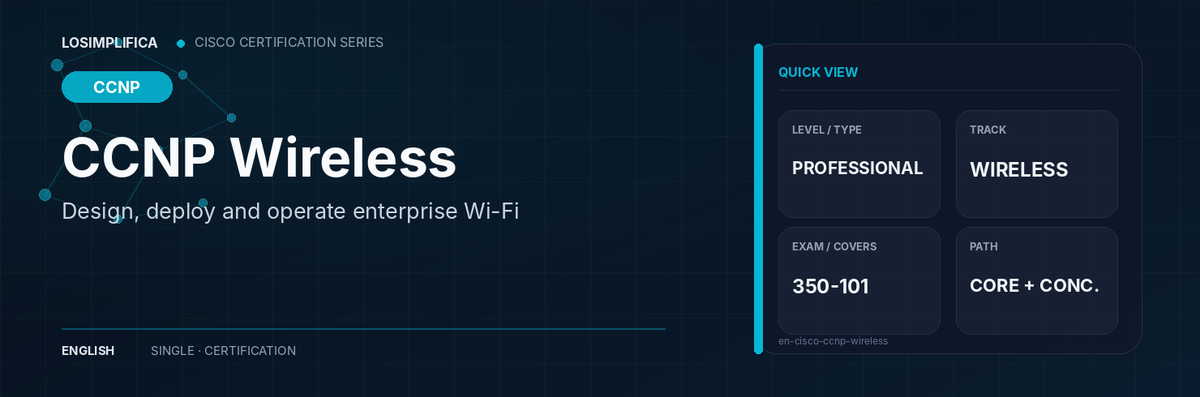
What is Cisco Certified Network Professional (CCNP) Wireless?
Cisco Certified Network Professional (CCNP) Wireless is Cisco's standalone professional certification for advanced enterprise wireless design, implementation, operations, and optimization. Candidates pass 350-101 WLCOR and either the WLSD design concentration or the WLSI implementation concentration. The track is now separate in the current Cisco career map.
Cisco lists no formal prerequisite, but that does not make preparation trivial. Learners often have three to five years implementing enterprise network solutions. The useful question is not whether a learner is allowed to register; it is whether the learner can explain and practice the published domains before paying for an attempt.
Quick facts
| Field | Current official information |
|---|---|
| Level | Professional |
| Track | Wireless |
| Requirement | Pass 350-101 WLCOR plus one current Wireless concentration exam |
| Primary exam | 350-101 WLCOR |
| Minimum exam fees | Core US$400 + one concentration US$300; taxes may apply |
| Primary exam duration | 120 minutes |
| Concentration exam duration | 90 minutes |
| Official exam languages | Source conflict: exams-and-training says English | Japanese; current exam list says English |
| Validity | Three years |
| Delivery | Proctored written exams; online or in person |
| Formal prerequisites | None |
Our take
How to pick
Use CCNP Wireless as an anchor only for a dedicated enterprise wireless path. For a general network engineer, it is a specialization choice after broad foundations, not an automatic next certification.
What's new
- 2026-07-16 - The current Cisco catalog and career map present Wireless as a standalone Professional and Expert track.
Who it is for
It fits wireless engineers, architects, and operations specialists who already work with RF behavior, client connectivity, monitoring, assurance, and enterprise wireless platforms.
It is not the default professional step for every CCNA holder. Candidates whose work is mainly routing, switching, or general enterprise infrastructure should compare CCNP Enterprise.
Why it may be worth considering
The track gives wireless specialists a direct professional path instead of forcing the subject into a broader enterprise credential. That is useful because wireless design and operations depend on RF conditions, client behavior, and site-specific evidence that do not reduce to wired-network rules.
The certification should be evaluated against a specific role outcome, not as a generic signal of seniority. Choose Wireless for dedicated wireless architecture or implementation work. Choose Enterprise when wireless is only one part of a broader network role.
Where this certification fits
Compare all professional tracks in Which CCNP Track Should You Choose?. At professional level, the track and concentration should reflect real work or a clearly defined target role.
Path position
| Foundation or previous step | Current certification | Common next step |
|---|---|---|
| CCNA-level networking plus practical enterprise Wi-Fi experience | CCNP Wireless | CCIE Wireless, wireless design/implementation specialization, or an RF architecture role |
This is a common progression, not a mandatory prerequisite chain.
Exam overview and skills covered
CCNP Wireless requires 350-101 WLCOR plus one current Wireless concentration. The core connects RF behavior, 802.11 operation, infrastructure, security, client connectivity, monitoring, and automation.
Modern wireless context: Wi-Fi 6, 6E, Wi-Fi 7, and 6 GHz
Wireless engineers should understand how 802.11ax underpins Wi-Fi 6, how Wi-Fi 6E extends that generation into 6 GHz, and how 802.11be/Wi-Fi 7 introduces new capabilities and client-design considerations. In 6 GHz, mechanisms such as Preferred Scanning Channels (PSC) and Reduced Neighbor Reports (RNR) help clients discover networks without scanning every channel in the same way used in older bands. WPA3 and enterprise authentication remain central to secure deployment and compatibility planning.
Treat this as current engineering context. Do not assume every one of these details has a separately published exam weight.
Wireless terms quick reference
| Term | Simple meaning | Why it matters |
|---|---|---|
| dBm | Absolute signal or power level referenced to one milliwatt | Wireless receive levels are often negative; a value closer to zero is stronger |
| dB | Difference between two power levels | Used for gains, losses, and link-budget comparisons |
| dBi | Antenna gain relative to an ideal isotropic radiator | Changes how energy is shaped; it does not create free power |
| RSSI | Vendor/device-reported received-signal indicator | Useful for coverage, but not a complete measure of connection quality |
| SNR | Difference between desired signal and background noise | Often more useful than RSSI alone when judging usable quality |
| Noise floor | Background RF energy seen by the receiver | A rising noise floor reduces usable SNR |
| Channel utilization | How busy the channel is | A strong signal can still perform poorly on a congested channel |
Survey methods: predictive, passive, and active
| Dimension | Predictive survey | Passive survey | Active survey |
|---|---|---|---|
| How it works | Models RF from floor plans, materials, APs, antennas, and design assumptions | The survey adapter listens to nearby RF and 802.11 activity without associating to the target WLAN | The test client associates to the WLAN and sends/receives traffic while moving through the site |
| Main data | Predicted coverage, capacity, AP count, placement, and channel plan | RSSI, SNR, noise, channels, utilization, interference, and observed AP information | Throughput, loss, latency, retransmissions, association, and roaming behavior |
| Best use | Early design and what-if planning | RF validation, inventory, coverage checks, and interference investigation | Post-deployment performance, application experience, and roaming validation |
| Limitation | Accuracy depends on the model and input assumptions | Strong signal alone does not prove good application performance | Results depend on the capabilities and behavior of the test client |
A heat map can look green while users still complain. Strong RSSI does not guarantee a good experience when SNR is poor, the channel is congested, or roaming behavior is unstable.
Cost, duration, languages, and validity
The current recorded exam pricing is Core US$400 + one concentration US$300; taxes may apply. The primary exam duration is 120 minutes, and a required concentration exam is normally recorded as 90 minutes.
Cisco lists the credential validity as Three years. The current recertification note for this level is: Renew by eligible exam activity or 80 Continuing Education credits before expiration.
Fees shown in U.S. dollars are planning figures. Taxes, local currency conversion, vouchers, Cisco Learning Credits, language availability, remote-proctoring eligibility, and appointment inventory can change by location. Verify the checkout and appointment screens before payment.
Recorded official exam languages: Source conflict: exams-and-training says English | Japanese; current exam list says English.
How to register
- Create or confirm the Cisco account that will be used for the certification record. Use a stable personal email where possible.
- Complete the Certification Tracking System profile and make sure the legal name matches the identification that will be presented on exam day.
- Open the current official exam page from the sources below, confirm that the exam code and language are still active, and follow Cisco's authorized scheduling flow.
- Review delivery rules before paying. The recorded delivery method for this draft is: Proctored written exams; online or in person.
- Save the appointment confirmation and recheck identification, system, rescheduling, and check-in requirements before the appointment.
How to prepare
A good preparation plan moves from the official blueprint to evidence of performance. Reading alone is not enough, and practice questions should be used to diagnose gaps rather than to memorize answer patterns.
- Start with the official exam topics. Turn every domain and sub-objective into a checklist. Mark each item as explain, demonstrate, troubleshoot, or compare.
- Build the minimum foundation first. Do not use exam-specific material to hide missing basics. Cisco Networking Academy, Skills for All, Cisco U., and the official learning resources can fill different gaps.
- Practice the work, not only the vocabulary. Create a wireless design brief that states requirements, constraints, assumptions, and validation criteria. Analyze client connectivity and roaming problems using evidence from multiple layers rather than signal strength alone. Practice interpreting RF, interference, channel, and capacity information in a repeatable troubleshooting workflow. Automate or standardize one wireless validation task and document how results are checked.
- Use spaced review and error logs. Record why an answer, configuration, investigation, or design choice was wrong. Revisit the underlying concept before repeating the same question set.
- Run a final readiness review. Use the official blueprint to identify weak domains, then complete mixed practice and hands-on validation under realistic time constraints. No course or practice score guarantees a pass.
Official Cisco resources
- Official certification page: https://www.cisco.com/site/us/en/learn/training-certifications/certifications/wireless/ccnp-wireless/index.html
- Official exam and training page: https://www.cisco.com/site/us/en/learn/training-certifications/certifications/wireless/ccnp-wireless/exams-and-training.html
- Current Cisco exams list: https://www.cisco.com/site/us/en/learn/training-certifications/exams/list.html
- Cisco certification catalog: https://www.cisco.com/site/us/en/learn/training-certifications/certifications/index.html
- Recertification policy: https://www.cisco.com/site/us/en/learn/training-certifications/certifications/recertification/index.html
- Cisco career certification map: https://www.cisco.com/c/dam/en_us/training-events/certifications/career-path.pdf?cachemode=refresh
This draft does not add marketplace or affiliate links. Add an external preparation resource only after a standalone review exists in the review registry for the same language.