350-401 ENCOR: CCNP Enterprise Guide

What is Cisco Certified Network Professional (CCNP) Enterprise?
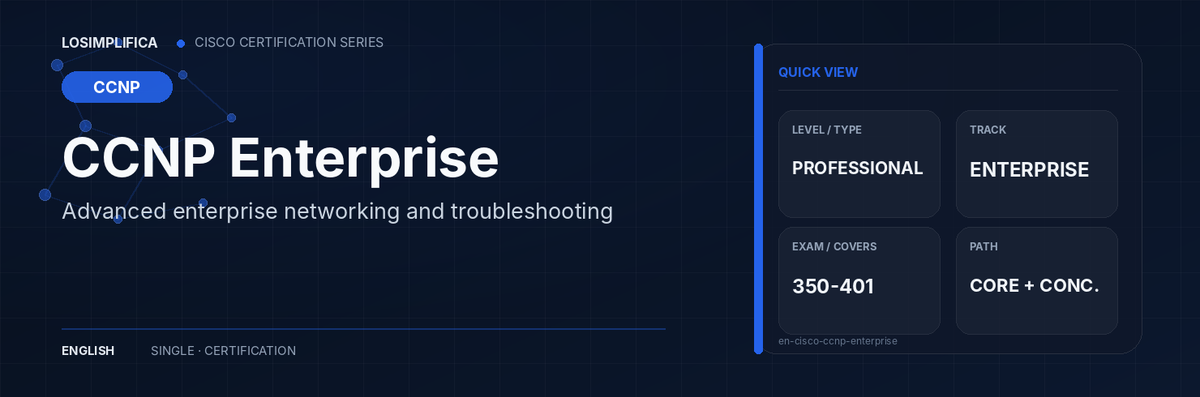
Cisco Certified Network Professional (CCNP) Enterprise is Cisco's professional-level certification for enterprise network design, implementation, operations, assurance, security, and automation. Candidates pass the 350-401 ENCOR core exam and one current Enterprise concentration. The core also serves as the qualifying written exam for the corresponding CCIE Enterprise Infrastructure path.
Cisco lists no formal prerequisite, but that does not make preparation trivial. Learners often have three to five years implementing enterprise network solutions. The useful question is not whether a learner is allowed to register; it is whether the learner can explain and practice the published domains before paying for an attempt.
Quick facts
| Field | Current official information |
|---|---|
| Level | Professional |
| Track | Enterprise Networking |
| Requirement | Pass 350-401 ENCOR plus one current Enterprise concentration exam |
| Primary exam | 350-401 ENCOR |
| Minimum exam fees | Core US$400 + one concentration US$300; taxes may apply |
| Primary exam duration | 120 minutes |
| Concentration exam duration | 90 minutes |
| Official exam languages | Core: English | Japanese; concentration language varies by exam |
| Validity | Three years |
| Delivery | Proctored written exams; online or in person |
| Formal prerequisites | None |
Our take
How to pick
Use CCNP Enterprise as the professional anchor when the role is genuinely broad enterprise networking. The concentration should follow the target work; do not select a concentration because it appears easiest or because an older guide lists it.
What's new
The content is stable. This feed will update as exam changes, retirements, or new reviews are confirmed.
Who it is for
It fits experienced enterprise network engineers, senior administrators, consultants, and designers who already work across routing, switching, services, assurance, security, and automation.
It should not be chosen only because Enterprise looks broad. Wireless, Service Provider, Automation, Security, and other professional tracks are better when the actual role is specialized.
Why it may be worth considering
CCNP Enterprise is valuable when the role spans multiple enterprise technologies and requires deeper troubleshooting or design judgment. The concentration choice lets the learner align the credential with advanced routing, SD-WAN, design, automation, cloud connectivity, or assurance work.
The certification should be evaluated against a specific role outcome, not as a generic signal of seniority. Use Enterprise for enterprise campus, branch, WAN, services, and assurance. Do not use it as a generic label for carrier networks, dedicated wireless engineering, or security operations.
Where this certification fits
Compare all professional tracks in Which CCNP Track Should You Choose?. At professional level, the track and concentration should reflect real work or a clearly defined target role.
Path position
| Foundation or previous step | Current certification | Common next step |
|---|---|---|
| CCNA or equivalent enterprise-networking experience | CCNP Enterprise | CCIE Enterprise Infrastructure, a deeper Enterprise concentration, or an adjacent architecture role |
This is a common progression, not a mandatory prerequisite chain.
Exam overview and skills covered
CCNP Enterprise requires 350-401 ENCOR plus one current Enterprise concentration exam. ENCOR and ENARSI are often studied together, but they solve different preparation problems.
ENCOR versus ENARSI
| Dimension | ENCOR 350-401: broad core and architecture | ENARSI 300-410: deep routing and troubleshooting |
|---|---|---|
| Role in the certification | Required core exam | Optional concentration exam |
| Main view | How enterprise architecture, infrastructure, wireless, security, assurance, and automation fit together | How advanced routing and services behave when configurations or paths fail |
| Technical emphasis | Enterprise design patterns, virtualization, infrastructure, assurance, security, automation | OSPF, EIGRP, BGP, redistribution, policy, VPN technologies, infrastructure services and security |
| Operating depth | Configure and verify major enterprise technologies and understand their interactions | Diagnose neighbors, routes, attributes, policies, filters, services, and path selection in detail |
| Typical question | “How does this architecture or control system work?” | “Why is the route missing, preferred incorrectly, or sending traffic along the wrong path?” |
| Lab focus | Multi-technology integration, controllers, automation, assurance, and end-to-end behavior | Repeated fault isolation with routing tables, protocol state, route maps, and show/debug evidence |
Routing-policy topics that deserve sustained lab time
- BGP: iBGP and eBGP relationships, path attributes, best-path reasoning, route reflectors, and IPv4/IPv6 address families.
- Route maps and filtering: match/set logic, tagging, attribute changes, redistribution, and policy control.
- Policy-Based Routing: forwarding selected traffic according to policy rather than the normal destination-only routing decision.
- OSPF and EIGRP: neighbor formation, path selection, summarization, metrics, filtering, and fault isolation.
- VRF-Lite and VPN context: how address families, route distinguishers/targets, and MPLS Layer 3 VPN concepts connect to enterprise routing.
The current blueprint expects candidates to configure, verify, and troubleshoot these areas. Treat them as lab work, not vocabulary work.
Current concentration choices
Use Cisco's current exam list before committing. ENARSI is a common routing-focused choice, but the Enterprise track also includes design, SD-WAN, wireless, and automation concentrations. Pick the concentration that matches the target work rather than assuming ENARSI is mandatory.
Cost, duration, languages, and validity
The current recorded exam pricing is Core US$400 + one concentration US$300; taxes may apply. The primary exam duration is 120 minutes, and a required concentration exam is normally recorded as 90 minutes.
Cisco lists the credential validity as Three years. The current recertification note for this level is: Renew by eligible exam activity or 80 Continuing Education credits before expiration.
Fees shown in U.S. dollars are planning figures. Taxes, local currency conversion, vouchers, Cisco Learning Credits, language availability, remote-proctoring eligibility, and appointment inventory can change by location. Verify the checkout and appointment screens before payment.
Recorded official exam languages: Core: English | Japanese; concentration language varies by exam.
How to register
- Create or confirm the Cisco account that will be used for the certification record. Use a stable personal email where possible.
- Complete the Certification Tracking System profile and make sure the legal name matches the identification that will be presented on exam day.
- Open the current official exam page from the sources below, confirm that the exam code and language are still active, and follow Cisco's authorized scheduling flow.
- Review delivery rules before paying. The recorded delivery method for this draft is: Proctored written exams; online or in person.
- Save the appointment confirmation and recheck identification, system, rescheduling, and check-in requirements before the appointment.
How to prepare
Start with the official ENCOR and chosen concentration blueprints, then organize preparation around evidence you can produce in a lab.
- Official exam topics: use them as the scope boundary and convert every objective into an explain/configure/verify/troubleshoot checklist.
- Cisco Press Official Cert Guides: use the current ENCOR and ENARSI guides to build a systematic knowledge base, but verify version-sensitive details against the current blueprint.
- Cisco Modeling Labs: build repeatable OSPF, EIGRP, BGP, redistribution, VRF, route-map, and failure-injection scenarios.
- Operational notebook: retain topology diagrams, configuration changes,
showoutput, expected versus actual behavior, root cause, and rollback notes for every lab.
Do not count a lab as complete because the final ping succeeds. Explain why the path is correct, which control-plane evidence proves it, and how the same design fails when one assumption changes.
Official Cisco resources
- Official certification page: https://www.cisco.com/site/us/en/learn/training-certifications/certifications/enterprise/ccnp-enterprise/index.html
- Official exam and training page: https://www.cisco.com/site/us/en/learn/training-certifications/certifications/enterprise/ccnp-enterprise/exams-and-training.html
- Current Cisco exams list: https://www.cisco.com/site/us/en/learn/training-certifications/exams/list.html
- Cisco certification catalog: https://www.cisco.com/site/us/en/learn/training-certifications/certifications/index.html
- Recertification policy: https://www.cisco.com/site/us/en/learn/training-certifications/certifications/recertification/index.html
- Cisco career certification map: https://www.cisco.com/c/dam/en_us/training-events/certifications/career-path.pdf?cachemode=refresh
This draft does not add marketplace or affiliate links. Add an external preparation resource only after a standalone review exists in the review registry for the same language.