350-201 CBRCOR: CCNP Cybersecurity Guide

What is Cisco Certified Network Professional (CCNP) Cybersecurity?
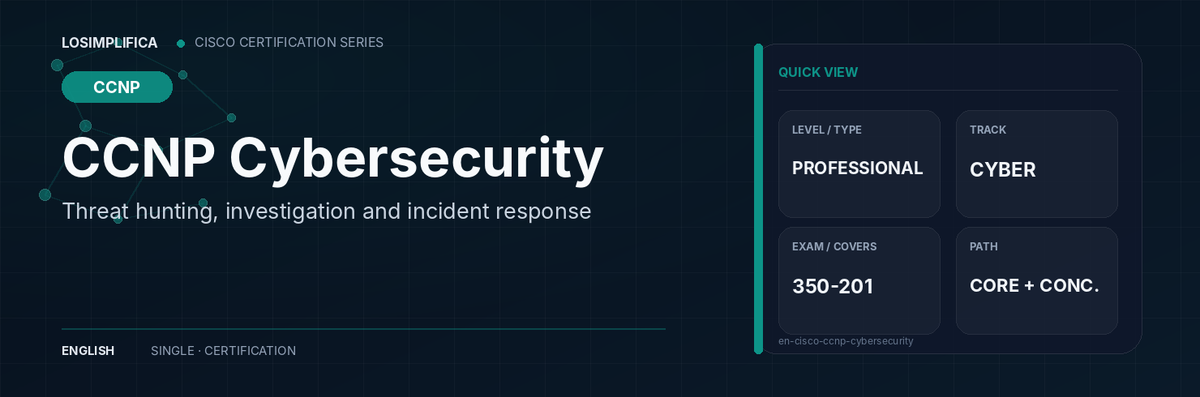
Cisco Certified Network Professional (CCNP) Cybersecurity is Cisco's professional certification for advanced cybersecurity operations, forensic analysis, incident response, threat hunting, and defense. Candidates pass 350-201 CBRCOR and one of two current concentrations: CBRFIR for forensics and incident response or CBRTHD for threat hunting and defense. The credential is the current canonical successor to CyberOps Professional naming.
Cisco lists no formal prerequisite, but that does not make preparation trivial. Candidates often have three to five years implementing enterprise networking or cybersecurity solutions. The useful question is not whether a learner is allowed to register; it is whether the learner can explain and practice the published domains before paying for an attempt.
Current naming matters. Cisco now uses Cisco Certified Network Professional (CCNP) Cybersecurity as the canonical credential name. Older references may use Cisco Certified CyberOps Professional, CyberOps Professional; this draft keeps those terms only as historical aliases, not as the page title, tag, or slug authority.
Quick facts
| Field | Current official information |
|---|---|
| Level | Professional |
| Track | Cybersecurity Operations |
| Requirement | Pass 350-201 CBRCOR plus one current Cybersecurity concentration exam |
| Primary exam | 350-201 CBRCOR |
| Minimum exam fees | Core US$400 + one concentration US$300; taxes may apply |
| Primary exam duration | 120 minutes |
| Concentration exam duration | 90 minutes |
| Official exam languages | English |
| Validity | Three years |
| Delivery | Proctored written exams; online or in person |
| Formal prerequisites | None |
Our take
How to pick
Use CCNP Cybersecurity as the professional anchor for advanced security operations. The most important boundary is CCNP Security: operations and investigation are not the same path as infrastructure controls.
What's new
The content is stable. This feed will update as exam changes, retirements, or new reviews are confirmed.
Who it is for
It fits SOC leads, senior analysts, incident responders, threat hunters, and security practitioners responsible for investigation quality and operational defense.
It is not the same as CCNP Security. Candidates focused on firewalls, identity services, secure access, and infrastructure controls should compare the Security track.
Why it may be worth considering
The certification is useful when the job requires evidence-driven decisions under uncertainty. It emphasizes operational processes and the ability to turn telemetry into defensible investigation, response, and hunting actions.
The certification should be evaluated against a specific role outcome, not as a generic signal of seniority. Choose CCNP Cybersecurity for SOC operations, investigation, incident response, and threat hunting. Choose CCNP Security for infrastructure security architecture and controls.
Where this certification fits
Compare all professional tracks in Which CCNP Track Should You Choose?. At professional level, the track and concentration should reflect real work or a clearly defined target role.
Path position
| Foundation or previous step | Current certification | Common next step |
|---|---|---|
| Strong networking/security foundations and practice with logs, packets, endpoints, and incidents | CCNP Cybersecurity | Senior SecOps, incident response, digital forensics, threat hunting, or detection-engineering work |
This path does not have a directly corresponding CCIE. Choose CCIE Security only when the target role shifts toward security infrastructure and architecture.
Exam overview and skills covered
CCNP Cybersecurity requires 350-201 CBRCOR plus one current concentration: 300-215 CBRFIR for forensics and incident response, or 300-220 CBRTHD for threat hunting and defense.
This track is about operating the defensive process: collecting evidence, detecting suspicious behavior, investigating incidents, and improving detection. Firewall and ISE implementation belong primarily to the separate CCNP Security infrastructure path.
MITRE ATT&CK as an investigation map
| Analyst question | ATT&CK concept that helps |
|---|---|
| What objective is the adversary pursuing? | Tactic |
| What behavior or method is being used? | Technique or sub-technique |
| What telemetry should reveal that behavior? | Data sources, data components, and observable activity |
| Where are detection and response gaps? | Coverage mapping against relevant techniques |
ATT&CK is a knowledge base of adversary tactics and techniques derived from real-world observations. Use it to organize threat hunting and detection coverage, not as a vendor product or a substitute for evidence.
Cisco Talos as a continuing intelligence resource
Cisco Talos is Cisco's threat-intelligence research organization. Its public research, advisories, blog, and threat resources can help learners connect exam concepts to current campaigns, vulnerabilities, malware behavior, and defensive recommendations. Do not treat a single intelligence report as proof that the same activity exists in your environment; correlate it with local telemetry.
From network engineering to SecOps: a three-step roadmap
- Build the observability base. Use your TCP/IP, DNS, routing, and authentication knowledge to read packet captures, flow records, endpoint telemetry, and identity logs. A network background is an advantage only when it is turned into investigation evidence.
- Master the security-operations core. Prepare for 350-201 CBRCOR through security fundamentals, analytical techniques, operational processes, investigation workflow, and automation.
- Choose the investigation direction. Use CBRFIR for digital forensics and incident response, or CBRTHD for threat hunting, threat modeling, adversary analysis, and defensive improvement.
Cost, duration, languages, and validity
The current recorded exam pricing is Core US$400 + one concentration US$300; taxes may apply. The primary exam duration is 120 minutes, and a required concentration exam is normally recorded as 90 minutes.
Cisco lists the credential validity as Three years. The current recertification note for this level is: Renew by eligible exam activity or 80 Continuing Education credits before expiration.
Fees shown in U.S. dollars are planning figures. Taxes, local currency conversion, vouchers, Cisco Learning Credits, language availability, remote-proctoring eligibility, and appointment inventory can change by location. Verify the checkout and appointment screens before payment.
Recorded official exam languages: English.
How to register
- Create or confirm the Cisco account that will be used for the certification record. Use a stable personal email where possible.
- Complete the Certification Tracking System profile and make sure the legal name matches the identification that will be presented on exam day.
- Open the current official exam page from the sources below, confirm that the exam code and language are still active, and follow Cisco's authorized scheduling flow.
- Review delivery rules before paying. The recorded delivery method for this draft is: Proctored written exams; online or in person.
- Save the appointment confirmation and recheck identification, system, rescheduling, and check-in requirements before the appointment.
How to prepare
A good preparation plan moves from the official blueprint to evidence of performance. Reading alone is not enough, and practice questions should be used to diagnose gaps rather than to memorize answer patterns.
- Start with the official exam topics. Turn every domain and sub-objective into a checklist. Mark each item as explain, demonstrate, troubleshoot, or compare.
- Build the minimum foundation first. Do not use exam-specific material to hide missing basics. Cisco Networking Academy, Skills for All, Cisco U., and the official learning resources can fill different gaps.
- Practice the work, not only the vocabulary. Run an investigation from an initial alert through scoping, evidence collection, timeline construction, containment recommendations, and reporting. Practice separating observed facts, analytical confidence, hypotheses, and unresolved questions. Build a small threat-hunting hypothesis and define the telemetry required to test it. Select CBRFIR or CBRTHD based on the target role rather than attempting both without a clear reason.
- Use spaced review and error logs. Record why an answer, configuration, investigation, or design choice was wrong. Revisit the underlying concept before repeating the same question set.
- Run a final readiness review. Use the official blueprint to identify weak domains, then complete mixed practice and hands-on validation under realistic time constraints. No course or practice score guarantees a pass.
Official Cisco resources
- Official certification page: https://www.cisco.com/site/us/en/learn/training-certifications/certifications/cybersecurity/ccnp-cybersecurity/index.html
- Official exam and training page: https://www.cisco.com/site/us/en/learn/training-certifications/certifications/cybersecurity/ccnp-cybersecurity/exams-and-training.html
- Current Cisco exams list: https://www.cisco.com/site/us/en/learn/training-certifications/exams/list.html
- Cisco certification catalog: https://www.cisco.com/site/us/en/learn/training-certifications/certifications/index.html
- Recertification policy: https://www.cisco.com/site/us/en/learn/training-certifications/certifications/recertification/index.html
- Cisco career certification map: https://www.cisco.com/c/dam/en_us/training-events/certifications/career-path.pdf?cachemode=refresh
This draft does not add marketplace or affiliate links. Add an external preparation resource only after a standalone review exists in the review registry for the same language.