350-801 CLCOR: CCNP Collaboration Guide

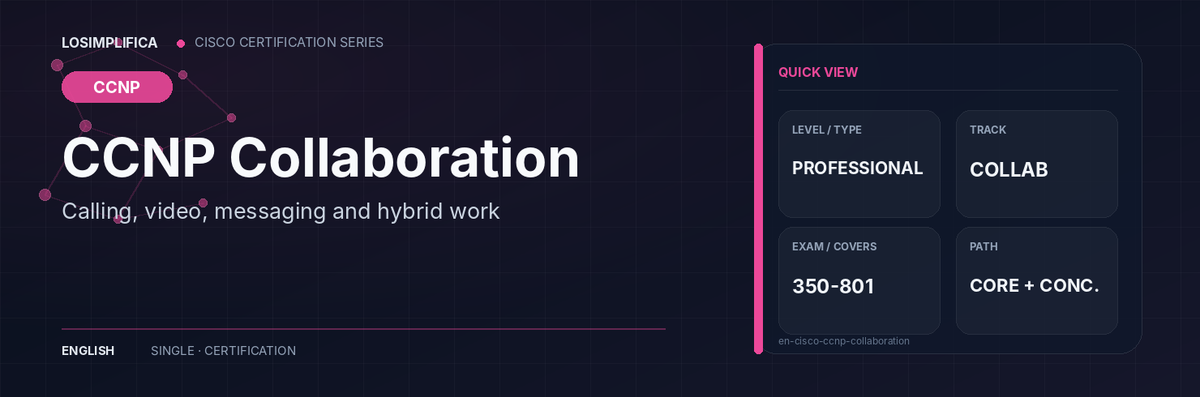
What is Cisco Certified Network Professional (CCNP) Collaboration?
Cisco Certified Network Professional (CCNP) Collaboration is Cisco's professional certification for collaboration infrastructure, calling, endpoints, media, quality of service, and cloud or hybrid collaboration services. Candidates pass 350-801 CLCOR and one current concentration: advanced on-premises call control, hybrid and cloud technologies, or cloud customer experience.
Cisco lists no formal prerequisite, but that does not make preparation trivial. Candidates often have three to five years implementing collaboration solutions. The useful question is not whether a learner is allowed to register; it is whether the learner can explain and practice the published domains before paying for an attempt.
Quick facts
| Field | Current official information |
|---|---|
| Level | Professional |
| Track | Collaboration |
| Requirement | Pass 350-801 CLCOR plus one current Collaboration concentration exam |
| Primary exam | 350-801 CLCOR |
| Minimum exam fees | Core US$400 + one concentration US$300; taxes may apply |
| Primary exam duration | 120 minutes |
| Concentration exam duration | 90 minutes |
| Official exam languages | English |
| Validity | Three years |
| Delivery | Proctored written exams; online or in person |
| Formal prerequisites | None |
Our take
How to pick
Use CCNP Collaboration as an anchor for a collaboration engineering path, not as a generic professional certification. The concentration should match the target environment: on-premises call control, hybrid/cloud, or cloud customer experience.
What's new
The content is stable. This feed will update as exam changes, retirements, or new reviews are confirmed.
Who it is for
It fits collaboration administrators, voice engineers, solution architects, and specialists responsible for enterprise calling, meetings, contact-center, or hybrid collaboration environments.
It is a role-specific track. A learner with no practical collaboration exposure should not select it simply because the exam count matches other CCNP tracks.
Why it may be worth considering
Collaboration systems combine network behavior, real-time media, call control, identity, endpoints, applications, and user experience. A dedicated path is useful because successful troubleshooting crosses several of those layers at once.
The certification should be evaluated against a specific role outcome, not as a generic signal of seniority. Choose Collaboration when voice, video, Webex, calling, or customer-experience infrastructure is central to the role. Choose Enterprise for broader network infrastructure work.
Where this certification fits
Compare all professional tracks in Which CCNP Track Should You Choose?. At professional level, the track and concentration should reflect real work or a clearly defined target role.
Path position
| Foundation or previous step | Current certification | Common next step |
|---|---|---|
| CCNA-level networking plus voice, video, or collaboration operations experience | CCNP Collaboration | CCIE Collaboration, hybrid/cloud collaboration specialization, or a collaboration architecture role |
This is a common progression, not a mandatory prerequisite chain.
Exam overview and skills covered
CCNP Collaboration requires 350-801 CLCOR plus one current Collaboration concentration. The core spans infrastructure, call control, endpoints, gateways, protocols, QoS, and collaboration applications.
SIP call flow and troubleshooting
Keep SIP methods separate from response codes. INVITE, ACK, and BYE are methods. 100 Trying, 180 Ringing, 200 OK, 404 Not Found, and 486 Busy Here are responses.
text INVITE ↓ 100 Trying ↓ 180 Ringing ↓ 200 OK ↓ ACK ↓ RTP media ↓ BYE ↓ 200 OK
SDP is carried inside signaling messages to describe media details such as codecs, IP addresses, and ports. A practical call investigation asks four questions: Did signaling complete? Did both sides agree through SDP? Did RTP media use the expected addresses and ports? If audio is one-way, which direction is blocked, translated incorrectly, or advertised with the wrong media address?
Partition and CSS: the lock-and-key model
| CUCM concept | Memory model | Practical role |
|---|---|---|
| Partition | Lock on a destination | Places a directory number, route pattern, or other dial-plan object into an access scope |
| Calling Search Space (CSS) | Key ring carried by the caller | Defines which partitions a line, device, gateway, or other calling context can search |
| Call result | Whether the key ring opens the lock | The destination's partition must be reachable through the effective CSS and call-routing logic |
A Partition is the lock attached to a destination. A CSS is the key ring carried by the caller. If the key ring does not include the partition, CUCM cannot reach that destination through that calling context.
In production, line and device CSS settings, route-pattern selection, transformations, local route groups, and other dial-plan behavior can also affect the final path.
Hybrid collaboration
Hybrid work makes the connection between on-premises CUCM and Webex cloud services an important design context. CLCOR should still retain its broad core focus. Deeper cloud and hybrid implementation belongs especially to 300-820 CLHCT, which covers Collaboration Hybrid and Cloud Technologies.
Cost, duration, languages, and validity
The current recorded exam pricing is Core US$400 + one concentration US$300; taxes may apply. The primary exam duration is 120 minutes, and a required concentration exam is normally recorded as 90 minutes.
Cisco lists the credential validity as Three years. The current recertification note for this level is: Renew by eligible exam activity or 80 Continuing Education credits before expiration.
Fees shown in U.S. dollars are planning figures. Taxes, local currency conversion, vouchers, Cisco Learning Credits, language availability, remote-proctoring eligibility, and appointment inventory can change by location. Verify the checkout and appointment screens before payment.
Recorded official exam languages: English.
How to register
- Create or confirm the Cisco account that will be used for the certification record. Use a stable personal email where possible.
- Complete the Certification Tracking System profile and make sure the legal name matches the identification that will be presented on exam day.
- Open the current official exam page from the sources below, confirm that the exam code and language are still active, and follow Cisco's authorized scheduling flow.
- Review delivery rules before paying. The recorded delivery method for this draft is: Proctored written exams; online or in person.
- Save the appointment confirmation and recheck identification, system, rescheduling, and check-in requirements before the appointment.
How to prepare
A good preparation plan moves from the official blueprint to evidence of performance. Reading alone is not enough, and practice questions should be used to diagnose gaps rather than to memorize answer patterns.
- Start with the official exam topics. Turn every domain and sub-objective into a checklist. Mark each item as explain, demonstrate, troubleshoot, or compare.
- Build the minimum foundation first. Do not use exam-specific material to hide missing basics. Cisco Networking Academy, Skills for All, Cisco U., and the official learning resources can fill different gaps.
- Practice the work, not only the vocabulary. Trace a call or session from endpoint registration through signaling, media, policy, and network dependencies. Practice isolating quality problems by separating signaling, media path, codec, bandwidth, loss, delay, and endpoint causes. Document a hybrid integration and identify which component owns authentication, routing, control, and user experience. Select a concentration based on the collaboration environment actually used by the target employer.
- Use spaced review and error logs. Record why an answer, configuration, investigation, or design choice was wrong. Revisit the underlying concept before repeating the same question set.
- Run a final readiness review. Use the official blueprint to identify weak domains, then complete mixed practice and hands-on validation under realistic time constraints. No course or practice score guarantees a pass.
Official Cisco resources
- Official certification page: https://www.cisco.com/site/us/en/learn/training-certifications/certifications/collaboration/ccnp-collaboration/index.html
- Official exam and training page: https://www.cisco.com/site/us/en/learn/training-certifications/certifications/collaboration/ccnp-collaboration/exams-and-training.html
- Current Cisco exams list: https://www.cisco.com/site/us/en/learn/training-certifications/exams/list.html
- Cisco certification catalog: https://www.cisco.com/site/us/en/learn/training-certifications/certifications/index.html
- Recertification policy: https://www.cisco.com/site/us/en/learn/training-certifications/certifications/recertification/index.html
- Cisco career certification map: https://www.cisco.com/c/dam/en_us/training-events/certifications/career-path.pdf?cachemode=refresh
This draft does not add marketplace or affiliate links. Add an external preparation resource only after a standalone review exists in the review registry for the same language.