350-901 AUTOCOR: CCNP Automation Guide

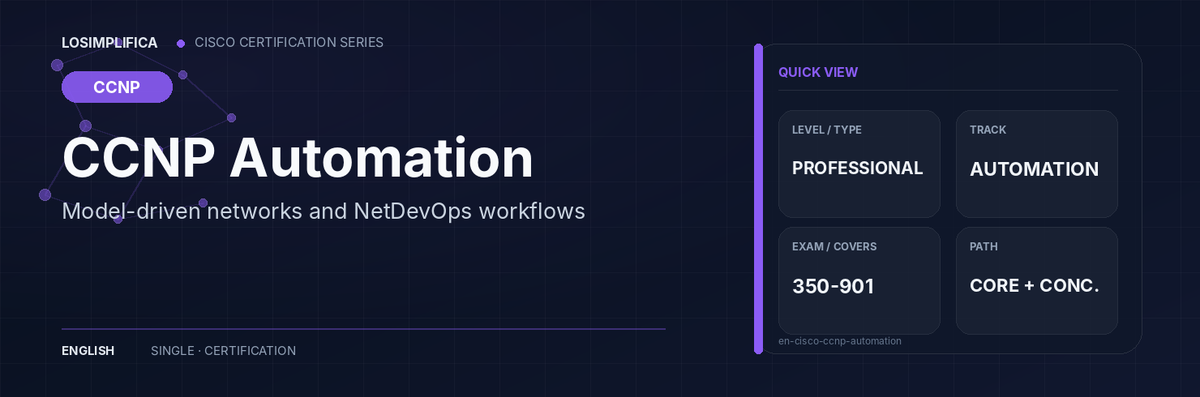
What is Cisco Certified Network Professional (CCNP) Automation?
Cisco Certified Network Professional (CCNP) Automation is Cisco's professional certification for designing, deploying, and operating network automation systems. Candidates pass 350-901 AUTOCOR and one current concentration: ENAUTO for enterprise automation or DCNAUTO for data center automation. The credential is the current canonical successor to DevNet Professional naming.
Cisco lists no formal prerequisite, but that does not make preparation trivial. Most learners have three to five years designing and implementing applications on Cisco platforms, including Python. The useful question is not whether a learner is allowed to register; it is whether the learner can explain and practice the published domains before paying for an attempt.
Current naming matters. Cisco now uses Cisco Certified Network Professional (CCNP) Automation as the canonical credential name. Older references may use Cisco Certified DevNet Professional, DevNet Professional; this draft keeps those terms only as historical aliases, not as the page title, tag, or slug authority.
Quick facts
| Field | Current official information |
|---|---|
| Level | Professional |
| Track | Automation |
| Requirement | Pass 350-901 AUTOCOR plus one current Automation concentration exam |
| Primary exam | 350-901 AUTOCOR |
| Minimum exam fees | Core US$400 + one concentration US$300; taxes may apply |
| Primary exam duration | 120 minutes |
| Concentration exam duration | 90 minutes |
| Official exam languages | Source conflict: exams-and-training says English | Japanese; current exam list says English |
| Validity | Three years |
| Delivery | Proctored written exams; online or in person |
| Formal prerequisites | None |
Our take
How to pick
Use CCNP Automation as the professional anchor for NetDevOps and infrastructure-development roles. For a network specialist, it is a broadening choice only when automation design is a material part of the job.
What's new
The content is stable. This feed will update as exam changes, retirements, or new reviews are confirmed.
Who it is for
It fits NetDevOps engineers, infrastructure developers, automation architects, and experienced network engineers whose role now includes software design, APIs, infrastructure as code, and automated operations.
It is not a beginner programming credential. Learners should be able to design and debug code, work with APIs and version control, and understand the infrastructure they are automating.
Why it may be worth considering
The credential is valuable when automation has to be reliable, secure, maintainable, and observable. Professional work is not just writing a script; it includes system design, failure handling, testing, deployment, and operational ownership.
The certification should be evaluated against a specific role outcome, not as a generic signal of seniority. Choose CCNP Automation for automation-system design and platform integration. Choose a technology CCNP when the main role is operating that technology and automation is only one supporting skill.
Where this certification fits
Compare all professional tracks in Which CCNP Track Should You Choose?. At professional level, the track and concentration should reflect real work or a clearly defined target role.
Path position
| Foundation or previous step | Current certification | Common next step |
|---|---|---|
| CCNA Automation or equivalent Python, API, Git, and infrastructure experience | CCNP Automation | CCIE Automation, a platform-automation role, or deeper automation inside another technology track |
This is a common progression, not a mandatory prerequisite chain.
Exam overview and skills covered
CCNP Automation requires 350-901 AUTOCOR plus one current Automation concentration exam. The current canonical core name is AUTOCOR; older DEVCOR references should be treated as historical material and checked carefully for version differences.
The professional-level challenge is not simply writing Python. It is designing an automation system that can be reviewed, tested, deployed, observed, secured, and recovered when something goes wrong.
Git and CI/CD in NetDevOps
text Create a branch ↓ Change automation code ↓ Run linting and tests ↓ Open a pull request ↓ Review and approve ↓ Merge ↓ Deploy to a lab ↓ Validate before production
Platforms such as GitHub Actions and GitLab CI can automate parts of this workflow by running tests and validation when code changes. They are practical examples, not Cisco-mandated exam products.
Model-driven automation: a three-part mental model
| Part | Technology | What it does |
|---|---|---|
| Model | YANG | Defines the structure, types, constraints, and relationships of configuration and operational data |
| Representation | XML or JSON | Encodes the modeled data so applications and devices can exchange it |
| Protocol or API | NETCONF or RESTCONF | Reads, changes, and validates YANG-modeled device data |
Think of it this way: YANG draws the blueprint. XML or JSON packages the information. NETCONF or RESTCONF carries the request to the device and returns the response. Some YANG models are standards-based; others are vendor- or platform-specific.
| Dimension | NETCONF | RESTCONF |
|---|---|---|
| Common secure transport | SSH | HTTPS |
| Data representation | XML | JSON or XML |
| Interaction style | RPC-based operations and datastores | REST-style HTTP methods and resources |
| Useful strengths | Structured configuration operations, validation, and datastore workflows | Familiar web-API integration and lightweight scripting |
| Typical Python approach | A NETCONF library such as ncclient |
An HTTP library such as requests |
RESTCONF is not simply a “better” NETCONF. Choose based on the platform, data model, transaction requirements, tooling, and operational controls.
Current concentration choices
- 300-435 ENAUTO: enterprise automation.
- 300-635 DCNAUTO: data center network automation.
Cost, duration, languages, and validity
The current recorded exam pricing is Core US$400 + one concentration US$300; taxes may apply. The primary exam duration is 120 minutes, and a required concentration exam is normally recorded as 90 minutes.
Cisco lists the credential validity as Three years. The current recertification note for this level is: Renew by eligible exam activity or 80 Continuing Education credits before expiration.
Fees shown in U.S. dollars are planning figures. Taxes, local currency conversion, vouchers, Cisco Learning Credits, language availability, remote-proctoring eligibility, and appointment inventory can change by location. Verify the checkout and appointment screens before payment.
Recorded official exam languages: Source conflict: exams-and-training says English | Japanese; current exam list says English.
How to register
- Create or confirm the Cisco account that will be used for the certification record. Use a stable personal email where possible.
- Complete the Certification Tracking System profile and make sure the legal name matches the identification that will be presented on exam day.
- Open the current official exam page from the sources below, confirm that the exam code and language are still active, and follow Cisco's authorized scheduling flow.
- Review delivery rules before paying. The recorded delivery method for this draft is: Proctored written exams; online or in person.
- Save the appointment confirmation and recheck identification, system, rescheduling, and check-in requirements before the appointment.
How to prepare
A good preparation plan moves from the official blueprint to evidence of performance. Reading alone is not enough, and practice questions should be used to diagnose gaps rather than to memorize answer patterns.
- Start with the official exam topics. Turn every domain and sub-objective into a checklist. Mark each item as explain, demonstrate, troubleshoot, or compare.
- Build the minimum foundation first. Do not use exam-specific material to hide missing basics. Cisco Networking Academy, Skills for All, Cisco U., and the official learning resources can fill different gaps.
- Practice the work, not only the vocabulary. Design an automation workflow with inputs, validation, authentication, error handling, logging, testing, and rollback. Represent infrastructure state in version control and review changes before applying them to a lab. Use APIs and data models to compare intended and observed state rather than assuming a successful request means a successful outcome. Choose ENAUTO or DCNAUTO based on the infrastructure context of the target role.
- Use spaced review and error logs. Record why an answer, configuration, investigation, or design choice was wrong. Revisit the underlying concept before repeating the same question set.
- Run a final readiness review. Use the official blueprint to identify weak domains, then complete mixed practice and hands-on validation under realistic time constraints. No course or practice score guarantees a pass.
Official Cisco resources
- Official certification page: https://www.cisco.com/site/us/en/learn/training-certifications/certifications/automation/ccnp-automation/index.html
- Official exam and training page: https://www.cisco.com/site/us/en/learn/training-certifications/certifications/automation/ccnp-automation/exams-and-training.html
- Current Cisco exams list: https://www.cisco.com/site/us/en/learn/training-certifications/exams/list.html
- Cisco certification catalog: https://www.cisco.com/site/us/en/learn/training-certifications/certifications/index.html
- Recertification policy: https://www.cisco.com/site/us/en/learn/training-certifications/certifications/recertification/index.html
- Cisco career certification map: https://www.cisco.com/c/dam/en_us/training-events/certifications/career-path.pdf?cachemode=refresh
This draft does not add marketplace or affiliate links. Add an external preparation resource only after a standalone review exists in the review registry for the same language.