200-301 CCNA Certification Guide

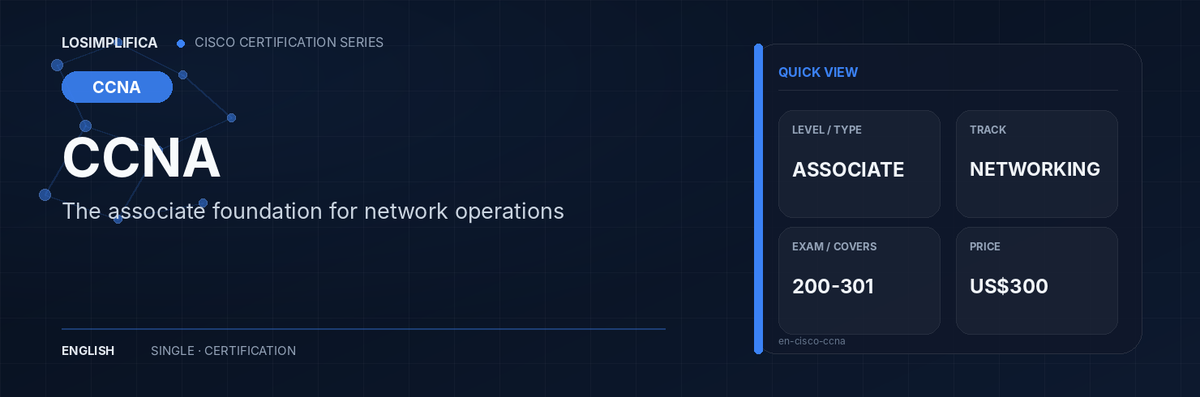
What is Cisco Certified Network Associate (CCNA)?
Cisco Certified Network Associate (CCNA) is Cisco's broad associate-level networking certification and the default networking anchor in the current career map. Think of it as a practical driver's license for networking: it does not make someone a senior engineer overnight, but it shows they can reason across the core systems that keep a production network reachable, segmented, secured, and manageable.
The 200-301 exam combines network fundamentals, access, IP connectivity, services, security fundamentals, and automation. Cisco lists no formal prerequisite, but that does not make preparation trivial. Learners often benefit from one or more years implementing and administering Cisco solutions. The useful question is not whether a learner is allowed to register; it is whether the learner can explain the published domains and prove the basics in a lab before paying for an attempt.
Quick facts
| Field | Current official information |
|---|---|
| Level | Associate |
| Track | Enterprise Networking |
| Requirement | Pass one required exam |
| Primary exam | 200-301 CCNA |
| Minimum exam fees | US$300, or Cisco Learning Credits; taxes may apply |
| Primary exam duration | 120 minutes |
| Concentration exam duration | Not applicable |
| Official exam languages | English | Japanese |
| Validity | Three years |
| Delivery | Proctored written exam; online or in person |
| Formal prerequisites | None |
Our take
How to pick
Use CCNA as the anchor for a broad networking path. It is usually a better first associate choice than stacking several specialized credentials without a role target; compare the three CCNA options before deciding.
What's new
- 2026-07-16 - Cisco's current career map states that a refreshed CCNA exam is scheduled to go live on February 3, 2027.
Who it is for
It fits aspiring network administrators, infrastructure support engineers, and IT generalists who need a working model of enterprise networking. Learners often benefit from prior hands-on exposure even though Cisco lists no formal prerequisite.
It is not automatically the best associate credential for every Cisco path. Candidates focused primarily on software-driven automation or SOC work should compare CCNA Automation and CCNA Cybersecurity before committing.
Why it may be worth considering
CCNA is worth considering when a role requires broad network literacy. In the networking world, it functions much like a practical driver's license: it shows that you have worked across addressing, switching, routing, services, security, and automation well enough to understand how the pieces interact.
That does not mean a new certificate holder is automatically ready to own a large production network. The value is the foundation: you can follow a packet's path, interpret device evidence, and approach a fault with a structured model instead of random commands.
Where this certification fits
Compare the three associate options in Which CCNA Should You Choose?. Pick one primary associate anchor based on the target role instead of assuming that all three form a standard sequence.
Path position
| Foundation or previous step | Current certification | Common next step |
|---|---|---|
| CCST Networking or equivalent networking fundamentals | CCNA | CCNP Enterprise, CCNP Wireless, another focused Cisco path, or an early network role |
This is a common progression, not a mandatory prerequisite chain.
Exam overview and skills covered
The current certification requirement is to pass 200-301 CCNA. The percentages below are Cisco's published domain weights. The final column is an editorial study priority, not a prediction of a specific exam form.
| Exam domain | Official weight | High-value study focus |
|---|---|---|
| Network Fundamentals | 20% | IPv4 and IPv6 addressing, subnetting, TCP/UDP, device roles, cabling, virtualization, and switching behavior |
| Network Access | 20% | VLANs, trunks, inter-VLAN connectivity, EtherChannel, Rapid PVST+, discovery protocols, and wireless infrastructure |
| IP Connectivity | 25% | Routing-table decisions, IPv4/IPv6 static routes, single-area OSPFv2, and first-hop redundancy concepts |
| IP Services | 10% | NAT, NTP, DHCP, DNS, SNMP, syslog, QoS, SSH, and file-transfer services |
| Security Fundamentals | 15% | Device access, ACLs, Layer 2 protections, AAA, VPN concepts, and wireless security |
| Automation and Programmability | 10% | Controller-based networking, APIs, REST, JSON, configuration-management concepts, and AI/ML in network operations |
Put extra lab time into static routing and OSPFv2
IP Connectivity is the largest domain. Build small topologies until you can explain why a route wins, configure and verify IPv4 and IPv6 default, network, host, and floating static routes, form a single-area OSPFv2 adjacency, and trace a failure back to addressing, interface state, neighbor formation, or the routing table.
Keep the versions straight: the current blueprint names OSPFv2 for IPv4 routing. It separately requires IPv6 addressing and IPv6 static routing; it does not list OSPFv3 as a CCNA configuration objective.
Layer 2 security: match the attack to the control
| Control | Main risk it reduces | How the control works |
|---|---|---|
| Port Security | MAC flooding and unauthorized devices on an access port | Limits learned source MAC addresses and handles violations through protect, restrict, or shutdown behavior |
| DHCP Snooping | Rogue DHCP servers that hand clients a malicious gateway or DNS configuration | Treats client-facing ports as untrusted and blocks server-originated DHCP messages that arrive from the wrong direction |
| Dynamic ARP Inspection | ARP spoofing and local man-in-the-middle attacks | Validates ARP information on untrusted ports, commonly against the DHCP snooping binding table |
Think of port security as a guest list for a switch access port. The port accepts a defined number of source MAC addresses and follows the configured violation action when an unexpected address appears.
cisco interface GigabitEthernet1/0/10 switchport mode access switchport port-security switchport port-security maximum 1 switchport port-security mac-address sticky switchport port-security violation restrict
maximum 1allows one secure MAC address on the port.stickylearns the observed address as a secure MAC address.restrictdrops violating traffic and records the violation without placing the port into an error-disabled state.
For DHCP snooping, the trusted interface is normally the network-facing path toward the authorized DHCP service, not simply “the DHCP port.” For DAI, remember that statically addressed devices may require ARP ACLs or other approved bindings because they may not appear in the DHCP snooping database.
These controls deserve focused lab practice because the current blueprint explicitly requires candidates to configure and verify them.
Cost, duration, languages, and validity
The current recorded exam pricing is US$300, or Cisco Learning Credits; taxes may apply. The primary exam duration is 120 minutes.
Cisco lists the credential validity as Three years. The current recertification note for this level is: Renew by eligible exam activity or 30 Continuing Education credits before expiration.
Fees shown in U.S. dollars are planning figures. Taxes, local currency conversion, vouchers, Cisco Learning Credits, language availability, remote-proctoring eligibility, and appointment inventory can change by location. Verify the checkout and appointment screens before payment.
Recorded official exam languages: English | Japanese.
How to register
- Create or confirm the Cisco account that will be used for the certification record. Use a stable personal email where possible.
- Complete the Certification Tracking System profile and make sure the legal name matches the identification that will be presented on exam day.
- Open the current official exam page from the sources below, confirm that the exam code and language are still active, and follow Cisco's authorized scheduling flow.
- Review delivery rules before paying. The recorded delivery method for this draft is: Proctored written exam; online or in person.
- Save the appointment confirmation and recheck identification, system, rescheduling, and check-in requirements before the appointment.
How to prepare
A good preparation plan moves from the official blueprint to evidence of performance. Reading alone is not enough, and practice questions should be used to diagnose gaps rather than to memorize answer patterns.
- Start with the official exam topics. Turn every domain and sub-objective into a checklist. Mark each item as explain, demonstrate, troubleshoot, or compare.
- Build the minimum foundation first. Do not use exam-specific material to hide missing basics. Cisco Networking Academy, Skills for All, Cisco U., and the official learning resources can fill different gaps.
- Practice the work, not only the vocabulary. Build and troubleshoot small switched and routed topologies, including IPv4 and IPv6 addressing. Spend disproportionate lab time on static routes and single-area OSPFv2: change one parameter, predict the result, verify the routing table and neighbor state, and then explain why traffic succeeds or fails. Also verify VLANs, trunks, common IP services, and basic device security from command output. Build a small access-switch lab for port security, DHCP snooping, and DAI, then test both expected and violating behavior. Read simple API data or automation examples so automation topics are connected to real network operations.
- Use spaced review and error logs. Record why an answer, configuration, investigation, or design choice was wrong. Revisit the underlying concept before repeating the same question set.
- Run a final readiness review. Use the official blueprint to identify weak domains, then complete mixed practice and hands-on validation under realistic time constraints. No course or practice score guarantees a pass.
Official Cisco resources
- Official certification page: https://www.cisco.com/site/us/en/learn/training-certifications/certifications/enterprise/ccna/index.html
- Official exam and training page: https://www.cisco.com/site/us/en/learn/training-certifications/certifications/enterprise/ccna/exams-and-training.html
- Official exam topics (v1.1 PDF): https://learningcontent.cisco.com/documents/marketing/exam-topics/200-301-CCNA-v1.1.pdf
- Current Cisco exams list: https://www.cisco.com/site/us/en/learn/training-certifications/exams/list.html
- Cisco certification catalog: https://www.cisco.com/site/us/en/learn/training-certifications/certifications/index.html
- Recertification policy: https://www.cisco.com/site/us/en/learn/training-certifications/certifications/recertification/index.html
- Cisco career certification map: https://www.cisco.com/c/dam/en_us/training-events/certifications/career-path.pdf?cachemode=refresh
This draft does not add marketplace or affiliate links. Add an external preparation resource only after a standalone review exists in the review registry for the same language.