200-201 CCNA Cybersecurity Certification Guide

What is Cisco Certified Network Associate (CCNA) Cybersecurity?
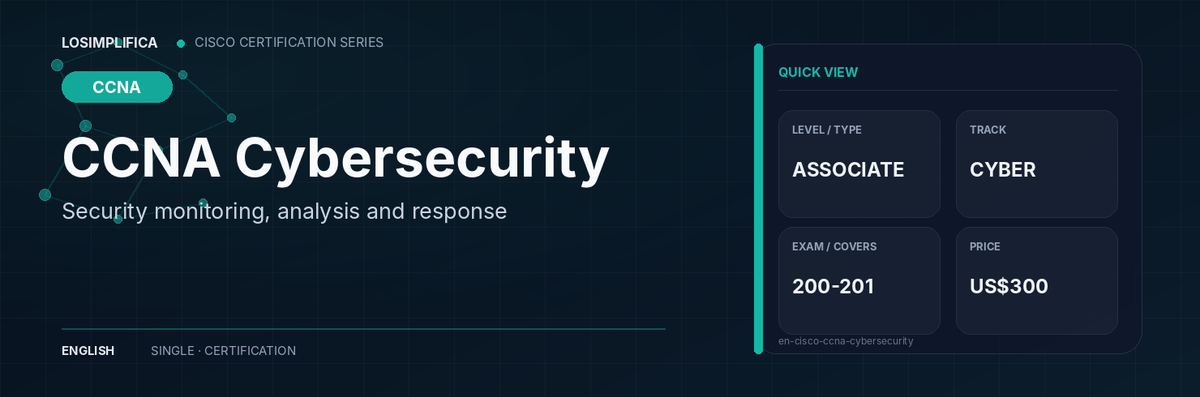
Cisco Certified Network Associate (CCNA) Cybersecurity is Cisco's associate-level certification for defensive cybersecurity operations. The 200-201 CCNACBR exam focuses on security concepts, monitoring, host-based analysis, network intrusion analysis, and operational policies and procedures. It is the current canonical name for the credential previously known as CyberOps Associate.
Cisco lists no formal prerequisite, but that does not make preparation trivial. Understand the published exam topics and build a preparation plan. The useful question is not whether a learner is allowed to register; it is whether the learner can explain and practice the published domains before paying for an attempt.
Current naming matters. Cisco now uses Cisco Certified Network Associate (CCNA) Cybersecurity as the canonical credential name. Older references may use Cisco Certified CyberOps Associate, CyberOps Associate; this draft keeps those terms only as historical aliases, not as the page title, tag, or slug authority.
Quick facts
| Field | Current official information |
|---|---|
| Level | Associate |
| Track | Cybersecurity Operations |
| Requirement | Pass one required exam |
| Primary exam | 200-201 CCNACBR |
| Minimum exam fees | US$300, or Cisco Learning Credits; taxes may apply |
| Primary exam duration | 120 minutes |
| Concentration exam duration | Not applicable |
| Official exam languages | English |
| Validity | Three years |
| Delivery | Proctored written exam; online or in person |
| Formal prerequisites | None |
Our take
How to pick
Use CCNA Cybersecurity as the associate anchor for a defensive operations path. It should not be positioned as a generic replacement for CCNA or as the same discipline as infrastructure-focused CCNP Security.
What's new
The content is stable. This feed will update as exam changes, retirements, or new reviews are confirmed.
Who it is for
It fits SOC analyst candidates, IT professionals moving into security operations, and learners who want to work with alerts, evidence, investigations, and response procedures.
It is not the same as CCNP Security or a network-security engineering path. Learners whose target is designing and operating firewalls, secure access, and infrastructure controls should compare the Security track.
Why it may be worth considering
The credential is worth considering when the goal is operational defense. It requires candidates to connect telemetry and evidence to a repeatable investigation process rather than treating individual security tools as the whole job.
The certification should be evaluated against a specific role outcome, not as a generic signal of seniority. Choose CCNA Cybersecurity for monitoring, analysis, and incident-oriented work. Choose broad CCNA for network administration and CCNA Automation for software-driven infrastructure work.
Where this certification fits
Compare the three associate options in Which CCNA Should You Choose?. Pick one primary associate anchor based on the target role instead of assuming that all three form a standard sequence.
Path position
| Foundation or previous step | Current certification | Common next step |
|---|---|---|
| Networking and security fundamentals, plus practice reading logs and traffic evidence | CCNA Cybersecurity | CCNP Cybersecurity, an entry-level SOC role, or deeper incident-response practice |
This is a common progression, not a mandatory prerequisite chain.
Exam overview and skills covered
The current exam is 200-201 CCNACBR v1.2. It is centered on defensive operations: monitoring, interpreting evidence, investigating suspicious activity, and following security policies and procedures.
| Security scenario | What the analyst asks | Likely evidence |
|---|---|---|
| Suspicious login activity | Is the user, device, location, or time unusual? | Authentication logs, identity alerts, account history |
| Malware on an endpoint | What process ran, what changed, and what did it contact? | Process tree, file hash, endpoint telemetry, persistence evidence |
| Suspicious network traffic | Does the behavior resemble scanning, exploitation, or command-and-control? | Packet capture, flow records, DNS data, IDS alerts |
| Phishing attempt | How did the message try to deceive the user, and where do its links or files lead? | Headers, URLs, attachment metadata, sandbox or reputation results |
| Potential security incident | What is affected, how severe is it, and who must be notified? | Alerts, logs, asset context, incident ticket, response procedure |
A small telemetry record can reveal a useful investigation lead:
text Source IP: 10.10.20.45 Destination IP: 198.51.100.18 Destination: TCP/443 Frequency: Every 60 seconds
A regular outbound interval can resemble beaconing and deserves investigation. It is not proof of malware by itself. A good analyst correlates the pattern with endpoint, DNS, identity, and threat-intelligence evidence before reaching a conclusion.
Cost, duration, languages, and validity
The current recorded exam pricing is US$300, or Cisco Learning Credits; taxes may apply. The primary exam duration is 120 minutes.
Cisco lists the credential validity as Three years. The current recertification note for this level is: Renew by eligible exam activity or 30 Continuing Education credits before expiration.
Fees shown in U.S. dollars are planning figures. Taxes, local currency conversion, vouchers, Cisco Learning Credits, language availability, remote-proctoring eligibility, and appointment inventory can change by location. Verify the checkout and appointment screens before payment.
Recorded official exam languages: English.
How to register
- Create or confirm the Cisco account that will be used for the certification record. Use a stable personal email where possible.
- Complete the Certification Tracking System profile and make sure the legal name matches the identification that will be presented on exam day.
- Open the current official exam page from the sources below, confirm that the exam code and language are still active, and follow Cisco's authorized scheduling flow.
- Review delivery rules before paying. The recorded delivery method for this draft is: Proctored written exam; online or in person.
- Save the appointment confirmation and recheck identification, system, rescheduling, and check-in requirements before the appointment.
How to prepare
A good preparation plan moves from the official blueprint to evidence of performance. Reading alone is not enough, and practice questions should be used to diagnose gaps rather than to memorize answer patterns.
- Start with the official exam topics. Turn every domain and sub-objective into a checklist. Mark each item as explain, demonstrate, troubleshoot, or compare.
- Build the minimum foundation first. Do not use exam-specific material to hide missing basics. Cisco Networking Academy, Skills for All, Cisco U., and the official learning resources can fill different gaps.
- Practice the work, not only the vocabulary. Review example alerts and identify what additional host, identity, and network evidence is needed. Practice reading basic packet, flow, and endpoint evidence without assuming that one indicator proves an incident. Write an incident timeline that separates observed facts from hypotheses and conclusions. Use a simple case workflow: triage, scope, evidence collection, containment recommendation, communication, and closure.
- Use spaced review and error logs. Record why an answer, configuration, investigation, or design choice was wrong. Revisit the underlying concept before repeating the same question set.
- Run a final readiness review. Use the official blueprint to identify weak domains, then complete mixed practice and hands-on validation under realistic time constraints. No course or practice score guarantees a pass.
Official Cisco resources
- Official certification page: https://www.cisco.com/site/us/en/learn/training-certifications/certifications/cybersecurity/ccna-cybersecurity/index.html
- Official exam and training page: https://www.cisco.com/site/us/en/learn/training-certifications/certifications/cybersecurity/ccna-cybersecurity/exams-and-training.html
- Current Cisco exams list: https://www.cisco.com/site/us/en/learn/training-certifications/exams/list.html
- Cisco certification catalog: https://www.cisco.com/site/us/en/learn/training-certifications/certifications/index.html
- Recertification policy: https://www.cisco.com/site/us/en/learn/training-certifications/certifications/recertification/index.html
- Cisco career certification map: https://www.cisco.com/c/dam/en_us/training-events/certifications/career-path.pdf?cachemode=refresh
This draft does not add marketplace or affiliate links. Add an external preparation resource only after a standalone review exists in the review registry for the same language.